






 Trap
 Normal
Battle of the Elements
View:
2703
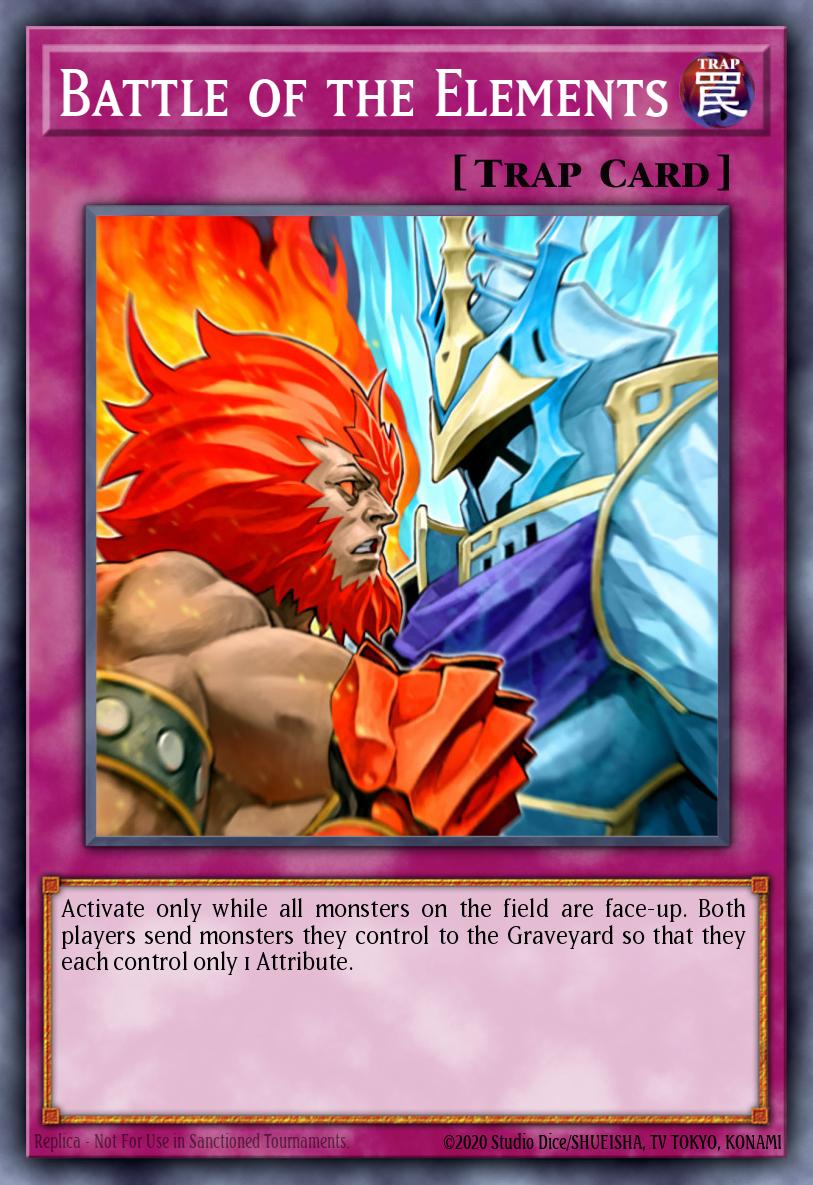
Activate only while all monsters on the field are face-up. Both players send monsters they control to the Graveyard so that they each control only 1 Attribute.
Battle of the Elements — Power Evaluation
Final Score: 44 ± 8 · Confidence: Medium
- Intrinsic: 48.2 · Deck: 41.7 · Meta: provisional
- Primary role: Board breaker · Secondary: Removal
Why it scores here
Battle of the Elements is a board-reset trap: it only activates when every monster on the field is face-up, and it sends both players' monsters to the Graveyard until each controls only one Attribute. Its value comes from clearing a board that the opponent is ahead on, not from building one. The evidence shows it is a single-copy tech card spread across 10 archetypes, with no combo, guide or usage data to show a repeatable conversion. Its listed partners are mostly the Mikanko and Kaiju cluster, so that signal reflects those two decks rather than the card's own synergy, and nothing in the evidence rewards the card's ATK or popularity.
Axis scores
| Axis | Score | Evidence |
|---|---|---|
| Accessibility | 40 | A face-down trap with no searcher or starter route in the evidence; it is reachable only when drawn and in decks that run a trap slot (inferred, 30-deck sample). |
| Combo & Conversion | 35 | Text-only inference: a mass-send reset that builds no board of its own and has zero recorded combo appearances (inferred). |
| Resource Economy | 40 | Symmetric send-to-GY hits the user's own monsters as well as the opponent's, so card economy is roughly even or slightly negative (inferred from text). |
| Effect & Interaction | 55 | Strong board-wide reach against multi-monster boards, but the all-face-up activation condition is easy to block with face-down monsters (verified text, inferred strength). |
| Material Utility | 0 | Trap card with no monster body, so it provides no material value (verified: card type Trap Card). |
| Resilience & Flexibility | 35 | One copy in most decks, no redundancy, and a fragile face-up condition that a single face-down monster defeats (inferred from text; 1-copy distribution observed in decks). |
| Deck-Building Efficiency | 65 | Single slot, one copy in 29 of 30 decks, legal in all four formats, and no garnet or lock cost (verified from copies distribution and formats). |
Calculation
Weight profile: 0.7 Board breaker + 0.3 Removal/Negation. Intrinsic ≈ 48.2, Deck ≈ 41.7, Meta = provisional. Modifiers: Self-inflicted restriction (-2). Final formula: 0.40*Intrinsic + 0.60*Deck
Strengths
- Mass board reset that hits the opponent's monsters at the cost of the user's own, letting the user recover a board they are behind on
- Legal in TCG, OCG, Master Duel and Duel Links with a single-copy, one-slot footprint
- Spread across 10 archetypes in the 30-deck sample, so it is portable between homes
Weaknesses
- Activation needs all monsters on the field to be face-up, so any face-down monster stops it
- Symmetric send hits the user's own board, which makes it a situational reset rather than a free win
- No combo, searcher or starter evidence, so it does not convert resources into board presence on its own
Counters / choke points
- Face-down monsters or set-based boards, which break the all-face-up activation condition (inferred from text)
- Negation of the trap itself, which the evidence does not quantify (gap)
Best use
Single-copy board-reset tech when the opponent holds a wider face-up board than the user. Decks: Mikanko, Kaiju, Mitsurugi, Fire King, Dogmatika. Suggested copies: 1.
Evidence & gaps
- Verified: Card text: activates only while all monsters are face-up; both players send monsters they control to the Graveyard until each controls only one Attribute; Trap Card type, no monster body, legal in TCG, OCG, MasterDuel and DuelLinks; Decks evidence: 30 decks, 10 distinct archetypes, 29 decks run 1 copy and 1 deck runs 3 copies; Gameplay type 7 in 28 of 30 decks (93.3%)
- Observed: Appears in 30 decks in the attached sample, with 1-copy use dominant; Top partner co_decks are concentrated in the Mikanko and Kaiju decks (about 80%); Zero recorded combo boards, so no starter, searched, material, payoff or end-board data exists
- Inferred: Board breaker is the primary role, with Removal as the secondary role, based on the text; Face-down monsters break the activation condition, which limits the card's reach in practice; Accessibility is low and situational because there is no searcher or starter route in the evidence
- Data gaps: no combos supplied, so combo conversion is text-only inference no guides supplied no usage statistics (StatisticsCard) available, so archetype inclusion is inferred only from the deck sample deck sample contains only decks that run the card, so the true inclusion rate is unknown card race is recorded as Normal on a Trap, which is inconsistent and was not used in scoring no banlist token supplied, so 3 copies assumed as the legal limit no official rulings supplied for the simultaneous send and Attribute interaction